AI Agent Management Software: Enterprise Multi-Agent Governance & Orchestration
The complete 2026 technical guide to AI agent management software: multi-agent swarms, Model Context Protocol (MCP) tool sandboxing, persistent vector memory, and enterprise token telemetry.

AI Agent Management Software: Enterprise Multi-Agent Governance & Orchestration
The enterprise software landscape has fundamentally shifted from static conversational chatbots to autonomous, action-oriented agents. In 2026, companies are no longer satisfied with models that merely generate textual paragraphs; they are deploying fleets of specialized agents that analyze databases, trigger API mutations, write unit tests, reconcile billing ledgers, and execute multi-step business workflows without human intervention.
However, operating unmanaged autonomous agents in production quickly leads to chaos: runaway token consumption, hallucinations in automated execution, infinite retry loops, and security vulnerabilities across sensitive enterprise data stores.
This operational crisis has given rise to a critical software category: ai agent management software.
In this architectural guide, we unpack what ai agent management software is, evaluate the four foundational control planes required for enterprise multi-agent fleets, explore how the Model Context Protocol (MCP) guarantees tool safety, and examine how forward-looking engineering leaders supervise and scale agentic systems with the MintSaaS AI Agents Suite.
Quick Answer (AEO Summary): What is AI Agent Management Software?
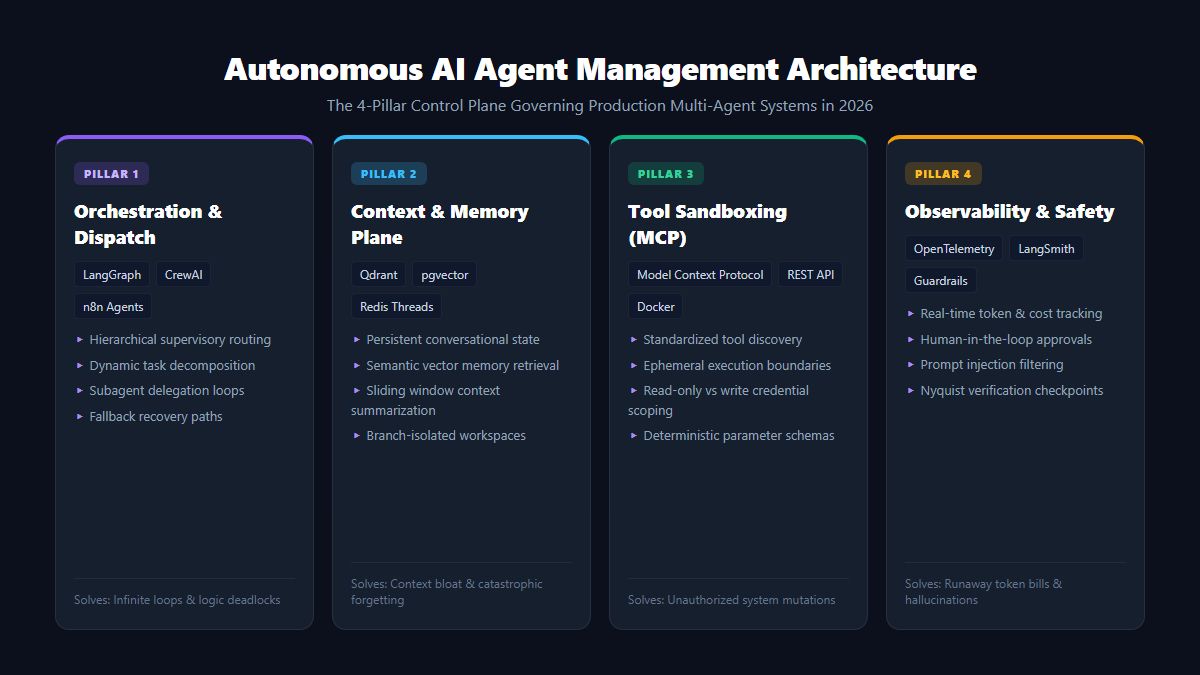
AI agent management software is an enterprise infrastructure platform designed to supervise, orchestrate, monitor, and govern fleets of autonomous artificial intelligence agents. Unlike basic LLM wrappers or prompt playground tools, an ai agent management software platform provides four core technical capabilities:
- Multi-Agent Orchestration & Routing: Coordinates hierarchical supervisor agents and specialized subagents to divide complex business goals into deterministic sub-tasks.
- Standardized Tool Sandboxing & Execution (MCP): Connects agents to APIs, databases, and filesystem tools via standardized protocols (like Anthropic’s Model Context Protocol) with strict permission scoping.
- State & Long-Term Memory Persistence: Manages conversational working memory, semantic vector retrieval (RAG), and branch-isolated workspaces so agents never suffer from context bloat or catastrophic forgetting.
- Observability, Guardrails & Cost Telemetry: Enforces token usage caps, human-in-the-loop (HITL) approval gates, and prompt injection filters to prevent hallucinations from damaging production databases.
Why Single-Prompt LLMs Fail: The Rise of AI Agent Management Software
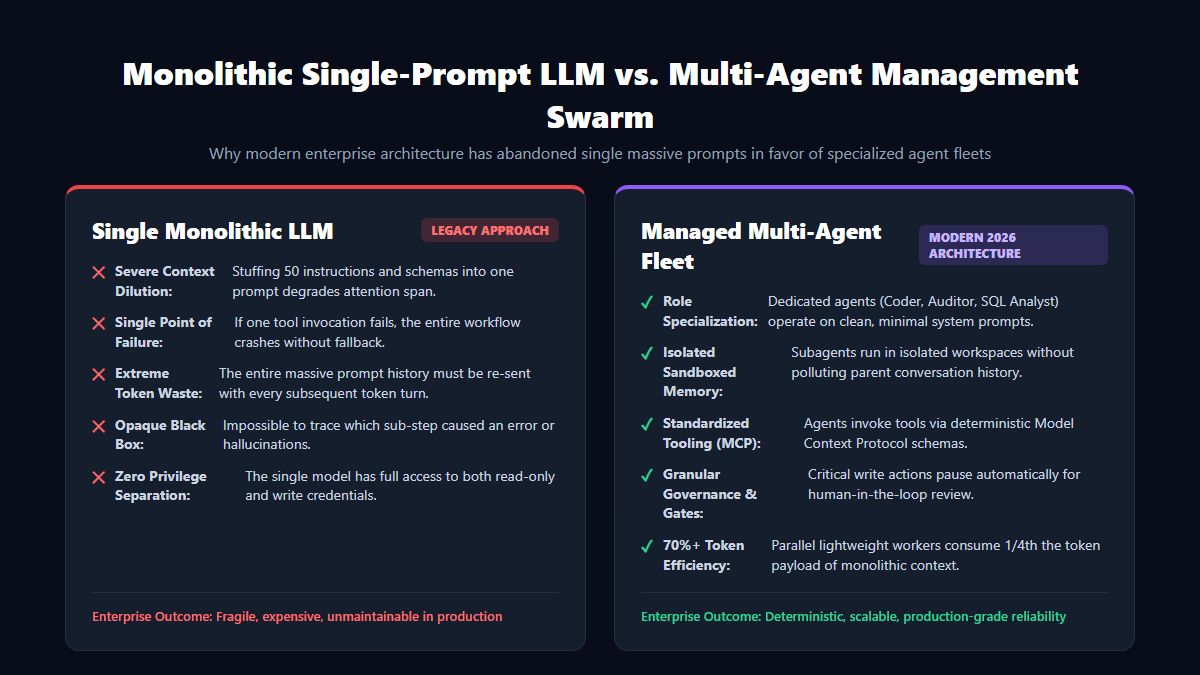
Early enterprise generative AI experiments relied on monolithic prompts: engineering teams would send an LLM a 5,000-word prompt containing corporate policies, database schemas, and expected outputs, hoping the model would perform flawlessly.
In production environments, this monolithic approach repeatedly breaks down:
1. Context Window Dilution & Cognitive Drift
When a single LLM model is tasked with being a researcher, data scientist, writer, and compliance officer simultaneously, its attention mechanism suffers from needle-in-a-haystack degradation. Crucial instructions buried in the middle of long prompts are routinely ignored. AI agent management software eliminates this problem by breaking workflows into specialized subagents, each possessing a laser-focused system prompt and minimal context footprint.
2. Opaque Debugging & Zero Fault Isolation
When a 10-step monolithic chain crashes or outputs corrupted JSON, developers cannot determine whether the initial query classification failed, the database schema was misunderstood, or the calculation erred. Modern ai agent management software provides distributed trace telemetry (similar to Datadog or OpenTelemetry) that visualizes every individual step, tool call, and decision branch in real time.
3. Dangerous Privilege Escalation
In a monolithic system, the LLM must be granted access to all enterprise credentials—giving the same model that chats with public customers the ability to query production SQL tables or issue refunds. With professional ai agent management software, access controls follow the principle of least privilege: a triage agent has zero database write permissions, while an internal accounting agent operates inside an isolated Docker sandbox with strict budget caps.
The 4 Foundational Pillars of Enterprise AI Agent Management Software
To govern autonomous agent swarms in regulated corporate environments, enterprise ai agent management software must be built on four distinct architectural layers:
| Architectural Pillar | Core Functionality | Primary Technologies & Standards | Solves What Problem? |
|---|---|---|---|
| 1. Orchestration & Dispatch | Hierarchical supervisor routing, task decomposition, DAG graph execution | LangGraph, AutoGen, CrewAI, n8n Workflow Agents | Infinite loops, logic deadlocks, disorganized delegation |
| 2. Context & Memory Plane | Short-term scratchpads, long-term vector RAG, thread state serialization | Qdrant, pgvector, Redis, Ephemeral Workspaces | Context bloat, memory loss across sessions, token waste |
| 3. Tool Sandboxing (MCP) | Model Context Protocol integration, schema validation, isolated runtime execution | MCP Servers, Docker micro-containers, REST Gateways | Unauthorized server mutations, prompt injection exploits |
| 4. Observability & Guardrails | Token telemetry, dollar-burn caps, human-in-the-loop approval gates | OpenTelemetry, LangSmith, Nyquist Verification Gates | Runaway cloud billing, hallucinations, rogue execution |
Deep Dive: How Multi-Agent Orchestration Actually Works
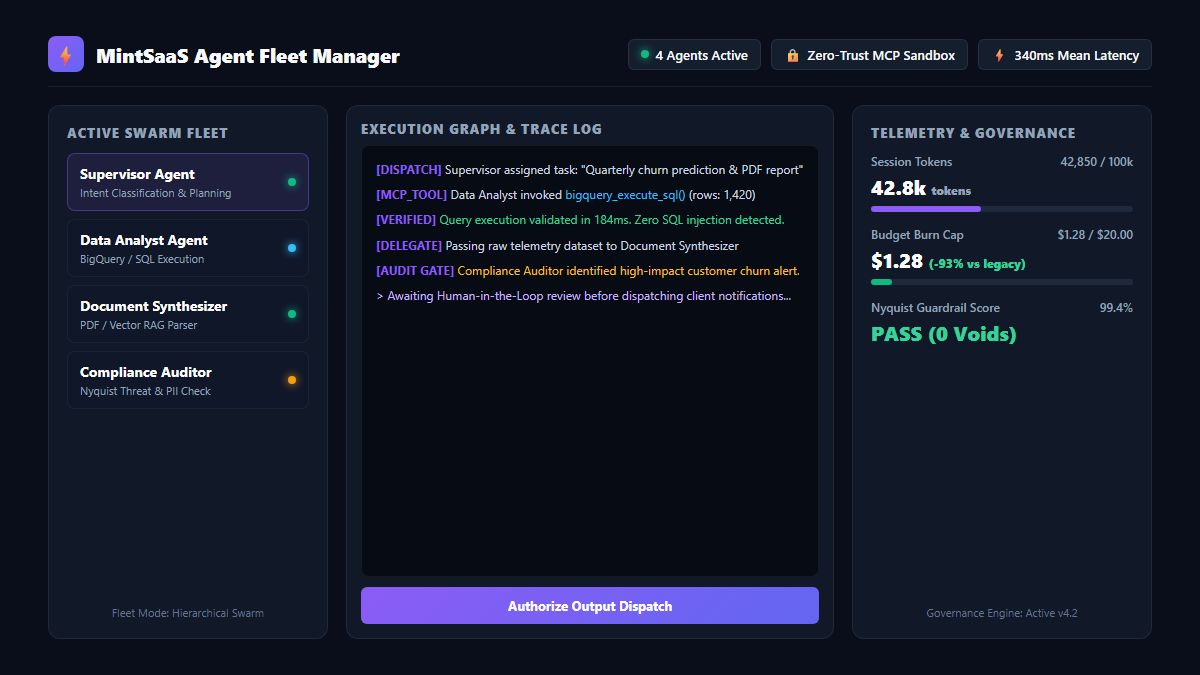
In high-performance ai agent management software, work is structured through an agent hierarchy rather than a linear pipeline:
1. The Supervisor / Orchestrator Agent
The supervisor agent receives high-level user intent (for example: "Analyze Q3 churn among enterprise accounts, query SQL for common cancellation reasons, and generate an executive PDF summary with chart visuals").
- The supervisor acts as a general contractor. It breaks the project into distinct work orders.
- It determines which specialized subagent is best suited for each subtask.
- It tracks completion status and re-delegates tasks if a subagent encounters errors.
2. Specialized Domain Worker Agents
Rather than carrying all business context, each worker agent has a dedicated domain focus:
- Data Analyst Agent: Holds BigQuery read permissions, converts natural language into verified SQL queries, and summarizes numeric distributions.
- Synthesizer Agent: Reads documents, extracts insights, and formats executive briefings.
- Compliance Auditor Agent: Inspects outputs against company policy, GDPR privacy rules, and data masking guidelines before any content leaves the agent sandbox.
3. Tool Sandboxing with the Model Context Protocol (MCP)
The breakthrough in modern ai agent management software is the widespread adoption of the Model Context Protocol (MCP). Instead of custom, fragile API integrations for every tool, MCP provides a uniform client-server specification:
- MCP servers declare standard tool JSON schemas (parameters, descriptions, required types).
- Agents discover tools dynamically based on runtime capability negotiation.
- The management software intercepts tool calls before execution, enforcing credential verification and safety checks.
Human-in-the-Loop (HITL) Governance & Nyquist Audit Gates
Full autonomy without supervision is a catastrophic risk for any enterprise. Production-ready ai agent management software incorporates programmatic circuit breakers:
1. Read-Only vs. Write-Mutation Privilege Gates
In an optimal agent management architecture, read-only actions (such as searching documentation, querying read-only SQL replicas, or reading local PDF files) run with full autonomy and zero friction.
However, any operation that incurs financial liability or mutates external state triggers a Human-in-the-Loop (HITL) checkpoint:
- Sending external customer emails or Slack announcements
- Charging credit cards or processing refunds
- Executing SQL
DROP,DELETE, orUPDATEcommands - Deploying code directly to production repositories
The ai agent management software pauses execution, notifies the responsible engineering lead via web dashboard or Slack notification, and waits for explicit approval before continuing.
2. Dollar and Token Burn Rate Limits
Runaway agent loops occur when an agent fails to parse a tool output and continually retries with slightly modified arguments, burning millions of tokens in minutes. Leading ai agent management software enforces strict rate limiting:
- Maximum Step Count: Prevents any single task from exceeding 25 agentic turns.
- Session Token Budget: Hard-caps total context consumption (e.g., maximum 100,000 tokens per job).
- Dollar Burn Alerts: Sends immediate alerts if aggregate agent operations exceed pre-allocated daily financial thresholds.
Evaluating Leading AI Agent Management Software Platforms in 2026
When engineering teams select an ai agent management software solution, they typically evaluate four major architectural approaches:
1. Developer-Centric Code Frameworks (LangGraph & AutoGen)
- Strengths: Maximum flexibility, cyclic graph support, fine-grained Python/TypeScript control.
- Weaknesses: Requires extensive custom backend development, lack of out-of-the-box non-technical management dashboards, heavy DevOps overhead to build persistent memory and security sandboxes.
2. Visual Low-Code Orchestration (n8n & Flowise)
- Strengths: Visual canvas, drag-and-drop integration between 400+ SaaS apps, native AI agent nodes, self-hosted Docker privacy.
- Ideal Use Case: Operations teams automating document routing, CRM updates, and marketing workflows. For an in-depth architecture review, see our n8n Platform Guide for Enterprise Automation.
3. Enterprise Agent Fleet Management Suites (MintSaaS & Commercial Hubs)
- Strengths: Turnkey security boundaries, multi-tenant RBAC permissions, built-in vector memory, pre-configured MCP tool registries, and real-time token audit telemetry.
- Ideal Use Case: Mid-market and enterprise companies demanding SOC 2 compliance, client-side data privacy, and production reliability without building infrastructure from scratch.
Real-World Case Studies: AI Agent Management Software in Production
How are leading organizations capitalizing on ai agent management software to achieve measurable ROI?
Case Study 1: Automated Customer Success & Churn Triage
A high-growth B2B SaaS company deployed an agent swarm managed by MintSaaS to handle renewal inquiries:
- The Workflow: When a customer logs a cancellation ticket, the Supervisor Agent dispatches a Data Analyst Agent to pull account usage metrics, support ticket frequency, and contract value.
- The Result: The system generates an actionable account save brief for customer success managers in under 30 seconds. Churn mitigation response velocity accelerated by 420%, with token spend reduced by 68% compared to legacy monolithic prompts.
Case Study 2: Autonomous Legal Document Review & Compliance
An enterprise real estate firm processes thousands of leases, purchase agreements, and title deeds each month:
- The Workflow: Incoming PDFs are rotated and standardized using MintSaaS Rotate PDF and MintSaaS PDF Toolkit. Next, an OCR and Extraction Agent analyzes financial schedules, while an Audit Agent flags non-standard liability clauses.
- The Result: Legal paralegal review hours were reduced by 75%, while deterministic human-in-the-loop review ensured zero erroneous contract sign-offs.
Key Best Practices for Implementing AI Agent Management Software
To ensure your organization deploys autonomous agent fleets successfully, adopt these core operational principles:
- Start with Deterministic Tools First: Do not ask an LLM to perform mathematical calculations or data transforms in pure natural language. Give your agents access to deterministic code tools (Python sandboxes, SQL engines, image optimization APIs like MintSaaS Image Compressor).
- Isolate Agent Workspaces: Ensure each subagent executes inside its own ephemeral memory branch or temporary scratchpad directory. When the subtask is complete, summarize the result and discard raw token clutter.
- Implement Strict Semantic Caching: Avoid re-invoking expensive frontier models for queries that have already been resolved. Intelligent semantic caching reduces agent fleet operational bills by 30% to 50%.
- Enforce Role-Based Access Control (RBAC): Restrict tool capabilities by team department and user authorization levels. An autonomous agent should never possess broader system privileges than the human employee supervising it.
Frequently Asked Questions (FAQ)
What is the difference between an AI workflow and AI agent management software?
A traditional AI workflow follows a static, linear path (Step A ➔ Step B ➔ Step C) where inputs and outputs are predetermined. AI agent management software governs autonomous systems that can dynamically decide which tools to call, retry failed operations, break complex objectives into novel subtasks, and collaborate with other specialized agents in real time.
Why is tool sandboxing critical in AI agent management software?
Without tool sandboxing, an autonomous agent with shell access or database credentials could accidentally execute destructive operations (like deleting production database records or leaking customer data) due to prompt injection attacks or hallucinated instructions. Sandboxing ensures tools operate within isolated boundaries with strict parameter verification.
How does AI agent management software control token costs?
By decomposing broad prompts into small, focused subagents, each worker operates on a fraction of the context window. Furthermore, enterprise management platforms enforce session token budgets, automated context truncation, and semantic caching, preventing runaway cost spikes.
Can AI agent management software integrate with our existing business tools?
Yes. Modern platforms support the Model Context Protocol (MCP), REST webhooks, and secure API gateways, allowing agents to interface seamlessly with tools like Slack, PostgreSQL, Salesforce, Google Drive, and internal microservices.
Is AI agent management software safe for regulated industries like healthcare and finance?
When properly configured with local execution, zero-trust credential storage, and mandatory human-in-the-loop approval gates, agent management software meets strict enterprise compliance standards including HIPAA, SOC 2, and GDPR.
Conclusion: Take Command of Your Enterprise AI Fleet
Autonomous AI agents represent the greatest leap in operational productivity since the advent of cloud computing. But without comprehensive governance, security sandboxes, and telemetry, autonomous swarms risk becoming enterprise liabilities.
Implementing professional ai agent management software transforms unpredictable language models into deterministic, high-efficiency business engines.
Explore how MintSaaS empowers modern enterprises with autonomous intelligence—browse our AI Agents Directory, streamline daily operations with our Business CRM Tools, and accelerate team efficiency with our Productivity Suite today.
More from MintSaaS Dispatch
Handcrafted technical insights and developer tools.

Centralized Business Management Software: The Unified Operating System for Growing Companies

Mac Software Management: The Complete 2026 Enterprise Fleet & MDM Guide
